
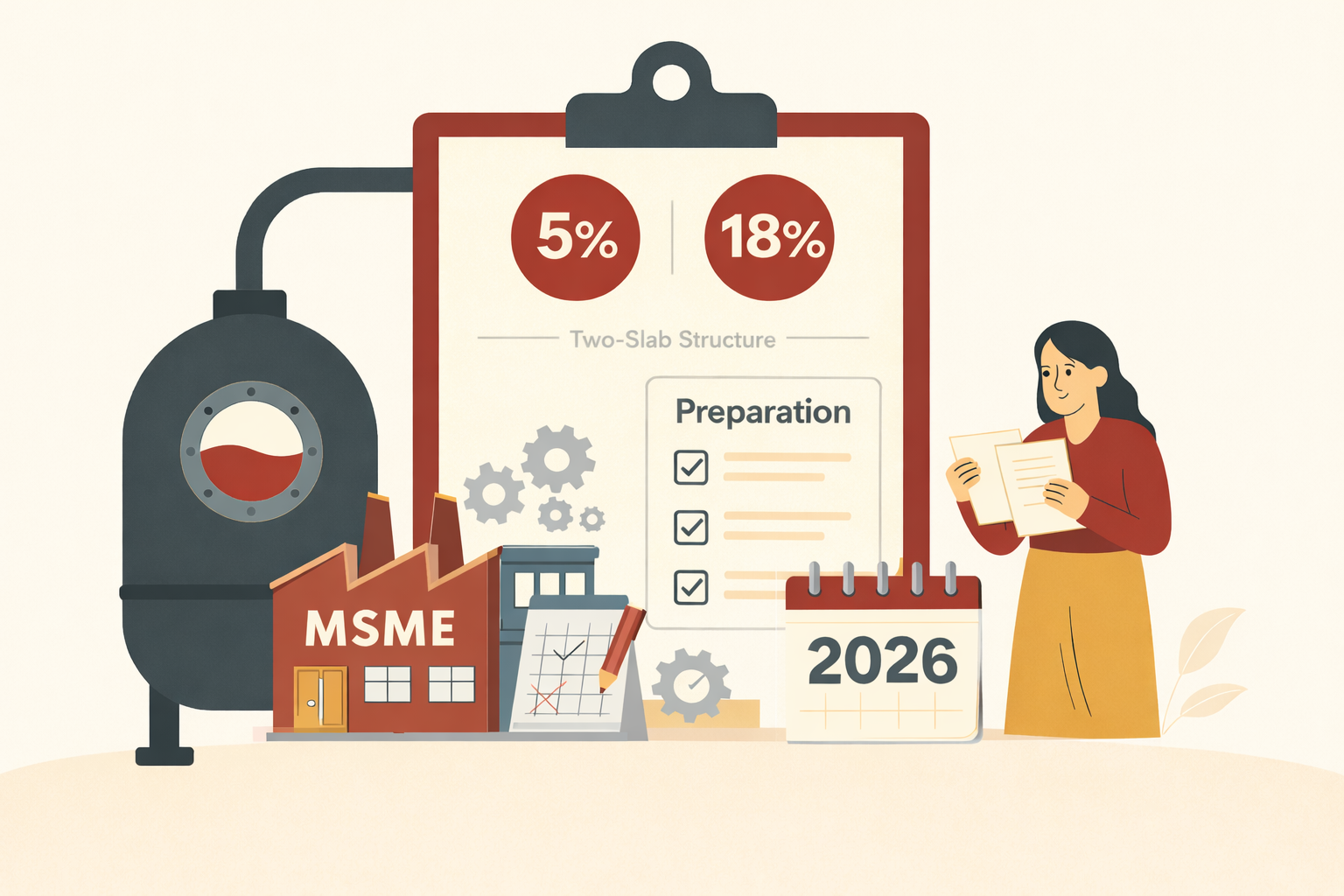
For years, the GST Council has been working on simplifying our Nation’s mutli-rate tax structure into just two primary slabs: 5% and 18%. While there is no official notification issued yet (as of February 17, 2026), the proposal is actively being discussed. Hence, the need for MSME to understand what it could mean for them and their businesses.
This change won’t just simplify rate classification, when implemented. It would change how MSME’s price products, manage cash flow, and prove compliance during audits. Let’s begin with what you need to know, and how to prepare for it without panicking.
Current GST Slab Structure (Simplified)
India currently has five main GST rates:
| GST RATE | DESCRIPTION |
| 0% | Essential items (fresh food, unprocessed agricultural goods) |
| 5% | Mass-consumption goods (sugar, tea, edible oils, fabrics) |
| 12% | Mid-range goods (frozen foods, computers, processed foods) |
| 18% | Standard goods and services (most MSME products fall here) |
| 28% | Luxury/sin goods (cars, tobacco, aerated drinks) |
| Plus, Cess | Applicable on luxury/demerit items |
Proposed Two-Slab Structure
The rationalization plan suggests:
| PROPOSED RATE | DESCRIPTION |
| 5% slab | Essentials and low-margin items |
| 18% slab | Most standard goods and services (absorbing the current 12% and 18% categories) |
| 40% slab | For premium or health-impact products such as tobacco and certain luxury items |
The goal for the proposed two-slab structure is to reduce classification disputes, improve compliance and its efficiency, and to stabilize GST revenue.
Business: Manufacturer of plastic packaging materials
Current GST rate: 12% on certain SKUs
Annual turnover: ₹8 crore
Before Rate Change:
Selling price per unit: ₹100 + 12% GST = ₹112
ITC available: 12% on raw materials
Comfortable margins
After Rate Change to 18%:
Option A: Absorb the tax → Selling price stays ₹112, but effective margin drops
Option B: Pass it on → New price ₹118, risking customer pushback
Option C: Renegotiate contracts → Time-consuming, may lose clients
What they did:
Ran a pricing impact analysis across 200+ SKUs
Notified customers 3 months in advance (before official notification)
Switched to automated GSTR-2B reconciliation to avoid ITC loss
Updated ERP system with new rate logic before the change took effect
Result: Smooth transition, zero compliance penalties, retained 95% of customers.
Myth 1: “Adjust when notified.”
Reality: 30-60 day rush = errors.
Myth 2: “CA handles it.”
Reality: You update systems/contracts.
Myth 3: “Customers absorb.”
Reality: They negotiate/switch.
Myth 4: “Simpler = easier.”
Reality: Faster error-spotting, stricter.
Focus of tax authorities will be shifted from debating rates to catching errors. Hence, expecting increased scrutiny on the following characteristics should be noted:
| ACTION | WHY IT MATTERS | DEADLINE |
| Audit all products under 12% GST | Identify pricing/margin impact if they move to 18% | Next 30 days |
| Review customer contracts | Add GST rate revision clauses to protect margins | Before renewals |
| Switch to monthly ITC reconciliation | Catch supplier errors before filing GSTR-3B | Immediate |
| Clean up HSN/SAC codes | Wrong codes = wrong rates = penalties | Next 60 days |
| Test your billing software | Ensure it can handle rate changes instantly | Before any notification |
| Automate GSTR-2B matching | Manual tracking fails under Rule 36(4) | Next quarter |
| Build a 3-month cash buffer | Rate changes strain working capital | Ongoing |
GST reforms assume businesses operate with:
Here's the truth: Manual compliance works when rules are loose. It fails catastrophically when systems become data-driven and unforgiving.
A simplified GST structure doesn't reduce your compliance burden; it raises the expectation of perfection.
Tax law changes aren't slowing down. Between GST updates, e-invoicing expansions, and TDS/TCS tweaks, MSMEs face a compliance treadmill.
Here's how we help you stay ahead:
Follow us for:
What you'll avoid:
The proposed GST two-slab structure (5% & 18%) is designed to simplify the tax framework, but it will also trigger:
The smart move? Don't wait for the notification. Strengthen your accounting discipline, automate reconciliation, and audit your pricing now, so when (or if) the change happens, you're already compliant.
Remember: Tax reforms don't ask permission. They just show up. The question is, will you be ready?


Leave a comment